The Halting Problem
Let's start with a practical scenario.
You work for some big tech company, [redacted], that offers a service that allows users to upload and run their own software in the cloud. The way that this works is that after a user uploads some code to the server, they can edit it, compile, and allow their own clients to run it. When a client requests to run a user's program, that program gets put on a queue somewhere and waits for its turn to complete whatever task it has been assigned.
This is a wonderfully successful service, and something like 60% of the internet makes its way onto the servers! This is great and all, but it turns out that the average user is not a great programmer: their programs are often buggy, and the worst are the ones that loop forever, i.e., they never halt. This is bad because it effectively means that nothing else on the queue after it gets to run! Your boss, [redacted], doesn't like this, and isn't pleased. So he asks you, his best programmer, to fix it.
One solution is of course to only let each program run for a certain amount of time. There are several issues with this, but suffice it to say that certain very important bits of software need to be allowed more time than others to get their tasks completed, and it's hard to know in advance how much time exactly that is. So your boss, [redacted], wants you to be smarter about it (the irony is not lost on you), and write some program that takes a block of code as input and decides whether or not that block of code compiles to a program that halts.
- Draw the Turing machine \(\mathcal T\).
- Is \(\lfloor\mathcal T\rfloor \mathtt{*s1{*}0} \in L_{Halt} \)?
- Is \(\lfloor\mathcal T\rfloor \mathtt{*s1{*}1} \in L_{Halt} \)?
- Is \(\lfloor\mathcal T\rfloor \mathtt{*s1{*}} \in L_{Halt} \)?
- Is \(\lfloor\mathcal T\rfloor \mathtt{*s2{*}0} \in L_{Halt} \)?
Effectively, what [redacted] is asking you to do is to design a decision procedure for \(L_{Halt}\). Unfortunately for your boss, this task is not possible.
Undecidability of the Halting Problem
Recall that we write \(\mathsf{Dec}\) for the family of all languages \(L \subseteq A^*\) such that there is a Turing machine \(\mathcal T\) with a state \(x\) such that \(x\) decides \(L\), i.e., \[ L = \{w \in A^* \mid \mathcal T_x(w) = 1\} \quad \text{and} \quad A^*\setminus L = \{w \in A^* \mid \mathcal T_x(w) = 0\} \] Then \(L_{Halt} \notin \mathsf{Dec}\). In other words, the halting problem is undecidable.
The proof is by contradiction: we are going to begin by assuming that \(L_{Halt}\) is decidable, and from that assumption conclude something absurd, like \(1 = 0\). If there is any proof in this class that you should pay attention to, it is this one!
| diag = | double_input.det_if_halt.goto liar |
| liar = |
if 0 : halt if 1 : goto loop |
| loop = | move right.move left.goto loop |
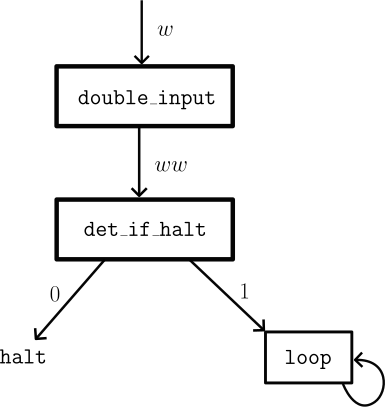 Now consider the input word
\[
w = \lfloor \mathcal D\rfloor \mathtt{* {diag} *}
\]
Does \(\mathtt{diag}\) halt on input \(w\)?
Let's check!
We can split this into two cases.
Case 1:
If \(\mathtt{diag}\) halts on input \(w\), then the output of running \(\mathtt{double\_input{.}det\_if\_halt}\) on the input word \(w\) must be \(0\), or else the \(\mathtt{liar}\) state enters the diverging \(\mathtt{loop}\).
Therefore, we must have
\[
0
= \mathcal H_{h}(ww)
= \mathcal H_{h}(
{\color{blue}\lfloor \mathcal D \rfloor} \mathtt{* {\color{red} {diag}} *} {\color{purple}\lfloor \mathcal D \rfloor \mathtt{* {diag} *}}
)
\]
But this word is a representation of a Turing machine (blue), state (red), and input (purple)!
Namely,
\[
{\color{blue}\lfloor \mathcal D \rfloor} \mathtt{* {\color{red} {diag}} *} {\color{purple}\lfloor \mathcal D \rfloor \mathtt{* {diag} *}}
= {\color{blue}\lfloor \mathcal D \rfloor} \mathtt{* {\color{red} {diag}} *} {\color{purple} w }
\]
By definition of \(\mathtt{det\_if\_halt}\), \(\mathcal H_{h}({\color{blue}\lfloor \mathcal D \rfloor} \mathtt{* {\color{red} {diag}} *} {\color{purple} w }) = 0\) implies that \(\mathtt{diag}\) never halts on \({\color{purple} w } = {\color{purple}\lfloor \mathcal D \rfloor \mathtt{* {diag} *}}\).
This contradicts the assumption at the beginning of this case.
Now consider the input word
\[
w = \lfloor \mathcal D\rfloor \mathtt{* {diag} *}
\]
Does \(\mathtt{diag}\) halt on input \(w\)?
Let's check!
We can split this into two cases.
Case 1:
If \(\mathtt{diag}\) halts on input \(w\), then the output of running \(\mathtt{double\_input{.}det\_if\_halt}\) on the input word \(w\) must be \(0\), or else the \(\mathtt{liar}\) state enters the diverging \(\mathtt{loop}\).
Therefore, we must have
\[
0
= \mathcal H_{h}(ww)
= \mathcal H_{h}(
{\color{blue}\lfloor \mathcal D \rfloor} \mathtt{* {\color{red} {diag}} *} {\color{purple}\lfloor \mathcal D \rfloor \mathtt{* {diag} *}}
)
\]
But this word is a representation of a Turing machine (blue), state (red), and input (purple)!
Namely,
\[
{\color{blue}\lfloor \mathcal D \rfloor} \mathtt{* {\color{red} {diag}} *} {\color{purple}\lfloor \mathcal D \rfloor \mathtt{* {diag} *}}
= {\color{blue}\lfloor \mathcal D \rfloor} \mathtt{* {\color{red} {diag}} *} {\color{purple} w }
\]
By definition of \(\mathtt{det\_if\_halt}\), \(\mathcal H_{h}({\color{blue}\lfloor \mathcal D \rfloor} \mathtt{* {\color{red} {diag}} *} {\color{purple} w }) = 0\) implies that \(\mathtt{diag}\) never halts on \({\color{purple} w } = {\color{purple}\lfloor \mathcal D \rfloor \mathtt{* {diag} *}}\).
This contradicts the assumption at the beginning of this case.